
Fussil Vases, a Generative Dialogue Between Nature and Design
Rooted in research and material experimentation, Graphis New Talent 2025 Gold winner, Strahinja Jovanović challenges the idea of design as a fixed act. With Fussil Vases , he allows algorithms, clay, and natural systems to shape form together, producing objects that feel grown rather than made.

Case Study by Strahinja Jovanović
How does nature design objects, and can we learn to design with its logic rather than merely
imitate its forms? What if design was not something we imposed on the world, but something
that grew from within it?
Fussil Design Vases emerged from th questions and from my desire to understand how nature
truly constructs form. At the core of my master’s thesis lies an exploration of nature as a
computational system—one governed by simple rules that generate complexity, adaptation,
and life itself. The project aims to move beyond biomimicry and into a co-designed system,
asking how designers might develop tools that allow nature’s algorithms to actively
participate in the creative process.
My inspiration comes from interdisciplinary fields such as biology, mathematics, and
informatics, particularly the work of Alan Turing on morphogenesis, Conway’s Game of Life,
and Darwinian evolution. I was drawn to systems that reveal how emergence arises from
simplicity. These references shaped not only the conceptual framework of the project but also
its methodology. Demonstrating how simple rules can generate an intelligence inherent in
nature itself.
The research and design strategy behind this project was deeply rooted in exploring simple
natural systems as generative engines—systems capable of producing new tools and,
ultimately, artifacts of a newly algorithmic nature. By examining how complexity emerges
from minimal rules, my work focused on understanding nature not as an aesthetic reference,
but as an operational logic.
Drawing primarily from Alan Turing’s research on morphogenesis and John Conway’s
studies on emergence, my investigation became centered on cellular automata. Cellular
automata represent systems of cells in which complexity arises from simplicity. Composed of
a grid of cells, each cell follows a small set of rules—allowing it to grow, transform, or
disappear based on the state of its neighboring cells. Individually, these rules are extremely
simple. Yet when repeated over time, they generate patterns that closely resemble natural
phenomena such as coral growth, leaf venation, erosion, or cellular life itself.


For my practice, cellular automata became more than a computational method; they evolved
into a design philosophy—one that replaces rigid control with emergence, prediction with
observation, and singular authorship with collaboration. Rather than designing a fixed
outcome, I designed conditions under which form could emerge.
Using creative coding with p5.js and d3.js, I experimented with developing new cellular
automata systems—algorithms that could be parametrically controlled by designers while
remaining open to unpredictability. Through these experiments, which included the creation
of various cell types and reactive behaviors, I developed Fussils: a generative design tool
based on cellular automata that unifies existing rules while allowing new ones to evolve. The
name derives from fossus (excavated) and futurus (future), reflecting the project’s position
between deep time and speculative design.
Within this tool, designers can generate a broad spectrum of cellular specimens capable of
producing diverse textures, forms, and spatial behaviors. These digital organisms can be
traced into three-dimensional space and materialized as design artifacts born from this newly
constructed system.
To ensure the project resonated with designers, researchers, and the broader creative
community, I focused on legibility between nature, algorithm, and artifact. A crucial step in
this process was translating digitally generated forms into physical objects. By doing so, I
introduced a sustainable, natural element—clay—into the workflow, completing a full cycle
between computation and materiality.
This transition from code to clay became a central component of the research. Using 3D clay
printing, I aimed to translate computational complexity directly into physical form with
minimal human intervention. One of the main challenges was achieving printable structures
without compromising the integrity of the generative system. I overcame this through
continuous iteration—adjusting parameters, embracing imperfections, and allowing the
behavior of the material itself to influence the final outcome.
Innovation within this project lies not only in the development of the tool, but in the creation
of a workflow that functions as an ecosystem—where algorithms, material, and human
decision-making coexist, negotiate, and evolve together.

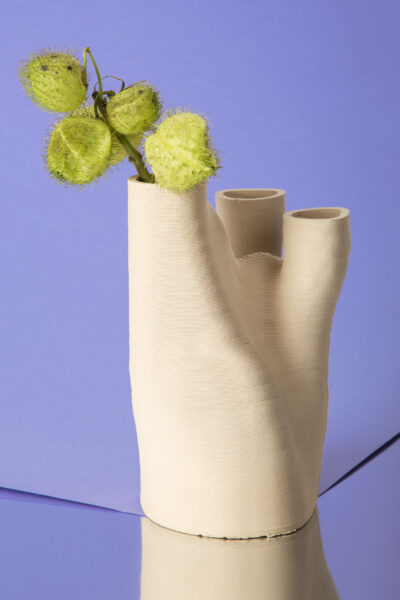
The outcome of the project is a series of 3D-printed clay vases, each unique in texture, scale,
and form. These objects act as intermediaries between the digital and the organic,
demonstrating how algorithmic systems can produce emotionally resonant, tactile artifacts.
This project fundamentally reshaped my creative perspective, reinforcing my belief that
design can function as a living dialogue rather than a fixed solution.
What brings me the most satisfaction is witnessing emergence—seeing forms appear that I
could not have fully predicted. Fussil Design pushed my creative boundaries by requiring me
to relinquish absolute authorship and trust systems larger than myself. I was surprised by how
naturally the digital translated into the physical and how clay amplified the narrative of
growth and erosion.
The greatest achievement of this project lies in how closely the vases align with my creative
identity. They are experimental, research-driven, and inseparable from nature’s processes,
carrying traces of both algorithm and clay, intention and accident, physical and digital. Fussil
Design represents my movement toward a more conscious design practice—one in which
design is not an act of finished statement, but an act of evolution, allowing objects to grow
from the conditions that surround them.
About Strahinja Jovanović
Strahinja is a designer and researcher driven by curiosity, experimentation, and the search for
meaning within systems. His work explores the dialogue between algorithms, nature, and
material processes, moving fluidly between two-dimensional and three-dimensional design.
Through hands-on experimentation and conceptual inquiry, he transforms abstract rules and
organic logic into physical and digital forms. Alongside research-based work, he creates
visual identities and objects marked by storytelling, clarity, and analitical framework of
design process. His practice embraces uncertainty and emergence, positioning design as a
space where intuition and structure coexist and where new forms can evolve.
Social: Website, LinkedIn, Instagram
Enter the next Graphis New Talent Awards here!
You may also like
A Collaboration of Mind, Music and Meaning, by Michael Pantuso and Ron Taft
When Michael Pantuso got a surprise call from Ron Taft, it sparked a creative partnership that gave…
Read MoreAntonio Castro H and the Beauty of Overlooked Species
Awarded Gold in the Graphis Poster Awards 2026, One World / One Chihuahuan Desert is a poster…
Read More
Related Annuals & Publications
View All


Become a Graphis Member
- 1-Year Membership Subscription
- Enjoy 50% off on Call for Entries
- Your Portfolio online with profile + links
- Get 20% off on Graphis Books